
Automated Content Generator: How to Pick One That Actually Publishes
An automated content generator can write and publish articles without manual effort — here's how they differ, what to look for
Most tools sold as an automated content generator do one thing: they draft text. You still choose the topic, review the output, paste it into your CMS, add the metadata, and hit publish. That's not automation — it's assisted typing. A fully automated system connects the full pipeline: it researches keywords, generates and optimizes a draft, formats it for your platform, and publishes or schedules it without you touching each step. Those systems exist, but they're a minority, and they come with real trade-offs around quality control.
The distinction matters because buyers routinely conflate the two. An AI writing assistant — ChatGPT, Claude, Jasper in its basic mode — accelerates the drafting step and nothing else. A true auto content generator owns the workflow from trigger to live URL. It does this by combining a large language model with an SEO data layer, a CMS integration, and some form of publishing logic; the orchestration layer is doing real work, not just the model. Whether that full pipeline can run without human review depends on the content type, the accuracy stakes, and how much brand voice consistency the work demands — and those three variables interact in ways that make a simple yes or no answer nearly impossible — all of which the rest of this piece works through.
What an automated content generator actually does (versus an AI writing assistant)
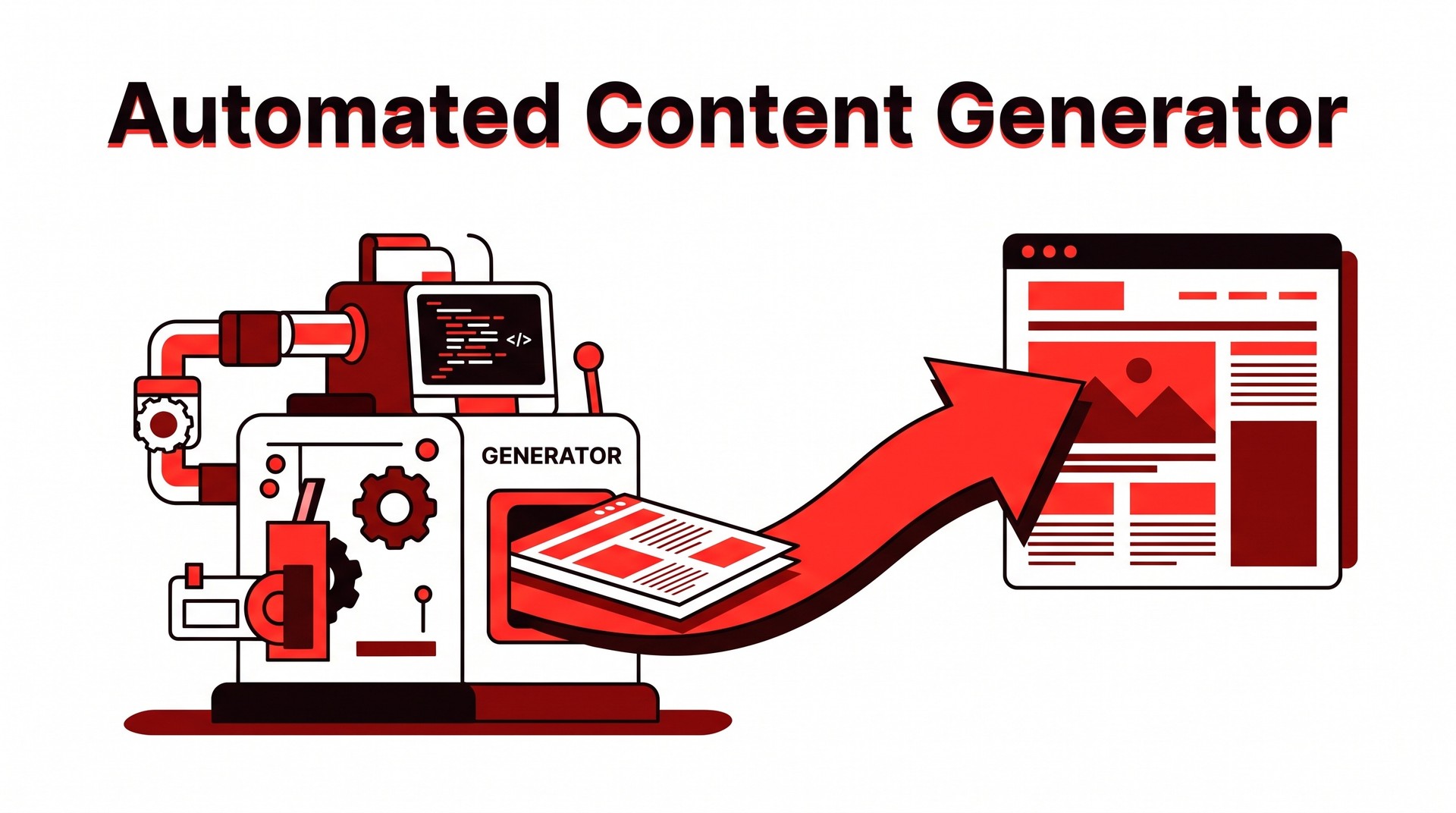
An automated content generator handles the full sequence — keyword selection, drafting, SEO optimization, and publishing to a CMS — without requiring you to touch every step, while an AI writing assistant produces a draft that you then edit, format, and post yourself. The distinction sounds simple. The marketing rarely honors it.
Most tools sold under the "automated" label stop somewhere in the middle. They'll take a topic, produce a draft, maybe suggest a title — and then hand the work back to you. Think of a hiring manager who uses software to screen CVs automatically but still sits in every interview: the tedious first pass is gone, yet a human still closes the loop. That's where most AI content tools live. The end-to-end picture of how automated content creation works is worth reading if you want to understand where the genre is headed and why most current products fall short of the label they claim.
A full pipeline covers three distinct stages: keyword or topic input (often pulled from an external rank-tracker or brief), content generation with on-page SEO baked in, and direct distribution — pushing the finished piece to WordPress, Webflow, or wherever your content lives. Each stage can be automated individually. The gap most products leave is between generation and publication: they hand you a Google Doc and call it automation. It isn't.
How to automate content generation: the four-stage pipeline
A working automated content pipeline runs through four discrete stages: keyword selection, brief generation, AI drafting, and publishing. Each can be partially or fully automated — but they fail at different rates, and the first stage is where most pipelines quietly fall apart.
Stage 1: Keyword and topic selection. Most tools let you paste in a keyword manually or connect to a source like Google Search Console, Ahrefs, or a keyword database to surface topics programmatically. Automated discovery sounds attractive, but the filtering logic still needs human judgment — volume thresholds, intent matching, competitive difficulty — and that judgment is harder to encode than most people expect. Encoding it properly takes longer than the initial setup. Skip this stage entirely and the generator writes fluently about things nobody searches for. That's the most common failure mode, and it stays invisible until you check organic traffic months later.
Stage 2: Brief and outline generation. Given a keyword, the tool builds a structured brief: target query, heading scaffold, competitor angle, word count, internal links to include. Freeform prompts produce flabbier output. Structured templates that specify sections, tone, and the semantic terms the draft should hit outperform open-ended instructions — which is less a writing tip than a systems-design observation, because the template is really just a mechanism for moving editorial decisions upstream where they can be reviewed and reused across dozens of future drafts without revisiting them each time. The brief is where you encode editorial judgment so the draft inherits it.
Stage 3: AI drafting and on-page SEO. The generator writes to the brief, embedding H2/H3 headers, distributing the target keyword at roughly the density the top-ranking pages use, and inserting internal link anchors where specified. Some tools also pull in SERP data mid-draft to adjust section emphasis.
Stage 4: Publishing. Straightforward, until it isn't. Direct CMS integrations — WordPress, Webflow, Ghost — push the draft into the correct template with metadata pre-filled, which removes a class of small errors that accumulate badly at scale. Copy-paste into a standard CMS is a minor friction; copy-paste into a custom CMS with no integration is where publishing schedules reliably slip.
Which types of content benefit most from automation — and which don't
Automation earns its place with high-volume, pattern-driven content — and exposes its limits almost immediately with anything that requires a named voice or primary evidence. The gap between those two categories is wider than most people expect.
✅ Strong fits:
Long-tail informational blog posts — "how to transfer files from iPhone to Mac," "best CRM for solo consultants" — follow predictable structures that automated pipelines handle reliably
FAQ pages and product description variants — templated output with consistent slot-filling logic
Location pages — nearly identical except for city name, local stats, and a handful of swapped phrases
❌ Weak fits:
Opinion pieces tied to a named author's credibility — the byline does more work than the prose; automation can't replicate earned trust
Investigative or primary-research content — if the article's value depends on interviews, data you collected, or access no one else has, there's nothing to automate
Crisis communications — too context-dependent and too consequential for templated logic
Social formats — TikTok scripts, YouTube video descriptions, Facebook post copy — sit in an interesting middle position. All three are automatable, but each needs its own prompt structure. A YouTube description wants keyword density and timestamp anchors; a TikTok hook needs a pattern interrupt in the first three seconds. Feeding both through the same prompt template produces mediocre output for both.
The B2B SaaS founder publishing three keyword-targeted informational articles per week through automation will almost always outrank a competitor releasing one hand-crafted piece per month — at least in the long-tail informational layer of search, where volume and coverage matter more than prose style. Volume wins there. Prose style becomes a meaningful differentiator only after a site has already matched a competitor's topical coverage — closing a gap that, if you look at how most content programs are actually structured, the majority of sites haven't come close to doing.
Is there a free automated content generator worth using?
Free automated content generators exist and are adequate for occasional use, but none of the commonly cited options — Copy.ai's free tier, the free version of ChatGPT, Google's Gemini — can publish to a CMS, score keyword difficulty, or run bulk generation without a paid plan. They generate text. That's where they stop.
The omissions follow a consistent pattern across all free tiers: no publishing integrations, no internal linking logic, no scheduling. Whatever the tool produces lands in a text box. Then comes the manual work. You copy it out, format it, upload it, add metadata, and optimize it — a chain of steps that, once you account for formatting and QA, can consume an hour or more per piece, which starts to dwarf what a mid-tier paid plan would cost for anyone producing more than a handful of articles a month.
There's also a reasonable argument that comparing what free AI writing tools actually include versus paid tiers saves time before you sign up for anything, since the feature gaps aren't always obvious from marketing pages.
The honest floor: if you're running a single-article experiment or validating a content angle before committing, free tools are perfectly serviceable. Scaling past that threshold makes paid automation the rational choice on time economics alone.
How to evaluate an auto content generator before you commit
The fastest way to separate useful automation from expensive noise is to ask one question before anything else: does the tool find the keywords, or does it wait for you to supply them? A tool that generates polished prose from topics you already know is a writing assistant. What separates an SEO system from that is the capacity to surface near-ranking opportunities and publish against them — two distinct products with different jobs.
Once that distinction is clear, work through the output side. Does it publish automatically? That question matters more than any feature list — because if the published article requires a second tool or a human review step to add a meta description, a correct H1/H2 hierarchy, and internal links, that friction belongs in your real cost calculation.
Which brings up the stack question. Some platforms replace four tools; others quietly require three more sitting beside them.
Criterion | Standalone AI Writers | Workflow Builders (Make/Zapier) | End-to-End SEO Platforms |
|---|---|---|---|
Keyword research | ❌ | ❌ | ✅ |
CMS publishing | Partial | ✅ (with setup) | ✅ |
Bulk generation | Partial | ✅ | ✅ |
SEO optimization | ❌ | Partial | ✅ |
Pricing tier | Low–Mid | Mid (plus tool costs) | Mid–High |
[Bold Pilot](https://boldpilot.club) fits the end-to-end column: it identifies near-ranking keywords, generates optimized articles, and publishes directly to your CMS without requiring a separate workflow builder. That's a reasonable fit if your goal is SEO-led publishing rather than general content production — brand content, social copy, or highly narrative pieces aren't what it's designed for, and trying to use it that way will feel like the wrong tool for the job.
The last checkpoint is bulk limits. Ask whether the pricing page shows a per-article cost or a monthly seat fee, and run the math at your actual publishing volume before committing.
What happens to content quality when you remove the human from the loop?
Three things degrade in predictable order when no human sees AI output before it publishes: factual drift on statistics, generic examples mismatched to the target audience, and inconsistent brand voice across a batch. These aren't random failures — they're structural, and they have structural fixes.
Factual drift is the quietest problem. An automated content generator will confidently cite a figure that was accurate eighteen months ago, or blend two separate studies into one nonexistent claim. Generic examples are more visible: a post aimed at enterprise procurement teams that uses a freelancer's invoicing scenario as its illustration. Brand voice inconsistency shows up across a batch rather than within a single article — piece twelve sounds nothing like piece three, because the prompt never encoded voice precisely enough.
The common belief that AI writing is inherently robotic is worth pushing back on. Undifferentiation is the real failure — content that could have been written for anyone, in any industry, addressing no audience in particular more precisely than any other. That's a prompt problem. A guide to writing with a natural, human-sounding AI voice covers how structured prompts reduce this gap mechanically, without relying on editorial instinct to paper over it each time.
What a human reviewer catches that automated checks don't: contextual misfits, tonal weirdness, claims that are technically true but misleading in context. Automated tools have their own lane — they catch repeated phrases, broken links, formatting drift, and readability scores with considerably more consistency than an editor skimming a fifteenth draft on a Friday afternoon after reviewing fourteen others. Build the latter into the pipeline and the former becomes a lighter, faster pass. Not a full edit on every draft.
FAQ
How to automate content generation?
Automating content generation means connecting four stages — topic discovery, drafting, optimization, and publishing — so that each one feeds the next without manual intervention. In practice, you can start with just one stage: plugging a keyword research tool into an AI writer, for instance, already removes the blank-page problem. A full pipeline adds an SEO layer and a CMS integration so that approved drafts move to your site on a schedule rather than sitting in a Google Doc waiting for someone to press publish.
Which is the best AI content generator?
There is no single best tool, because the right choice depends on which stage of your content process is the actual bottleneck. A standalone AI writer like Jasper or Claude handles drafting well but leaves research, optimization, and publishing to you; a platform like Surfer SEO or Clearscope adds the optimization layer on top; and end-to-end systems fold all four stages into one workflow, at a higher price and with less flexibility. Match the tool's scope to the gap in your process, not to a top-ten list.
Can AI be a content generator?
Yes — modern large language models can produce structured drafts from a brief, a keyword, or even a URL, covering research, outlining, and writing in one pass. The output quality depends heavily on how well the input is specified: a tight prompt with audience context, a target keyword, and a defined structure consistently outperforms a vague one. What AI cannot reliably replace is editorial judgment — deciding whether a piece is accurate, whether the argument holds, and whether it matches the voice your audience expects.
Is there a free AI content generator?
Several tools offer free tiers, most notably ChatGPT's free plan and the no-cost versions of Rytr or Copy.ai, though these typically cap the number of words or runs per month and stop well short of publishing automation. Free plans are useful for testing whether a tool's output style fits your needs before committing to a paid tier. If the bottleneck you're solving includes scheduling and CMS publishing — not just drafting — a free plan is unlikely to cover it, since those integrations almost universally sit behind a paywall.
How to decide which automated content generator is right for your workflow
The clearest way to frame this decision is to stop thinking about which tool is best-reviewed and start asking where your content process actually stalls. If drafts exist but stay in a queue for weeks because no one has time to optimize or upload them, a better AI writer doesn't help you — a CMS integration does. If the queue is empty because nobody knows what to write next, the gap is at the research end, and plugging in a keyword intelligence layer solves more than any tone-of-voice upgrade would.
A standalone AI writer is the right call when drafting itself is the time sink. Teams producing frequent short-form content — product descriptions, social copy, email sequences — often find that a drafting tool alone cuts their output time by more than half, without needing a publishing pipeline at all. The overhead of a full end-to-end system would be disproportionate for that use case, and the added complexity creates its own maintenance burden.
End-to-end pipelines earn their cost when two conditions are both true: you have a predictable, repeatable content type (SEO articles, newsletter digests, product-page variants), and the delay between "topic identified" and "content live" is where you're losing ground. Closing that loop is hard to replicate when separate tools are stitched together manually — each handoff introduces lag, formatting errors, and the quiet attrition of tasks nobody owns. But if either condition is missing, you're paying for automation that sits idle.
One thing worth pushing back on: many teams reach for an automated content generator because they want to publish more. The more useful question is whether publishing more — at the quality level automation currently delivers without tight human oversight — actually serves their goals. For a site where trust and depth are the competitive advantages, the answer is frequently no, and a slower, more edited process with selective AI assistance outperforms a high-volume pipeline that erodes that trust over time.
The concrete next step is an audit, not a purchase. Map your current content process stage by stage — topic sourcing, research, drafting, optimization, review, publishing — and mark every stage that still requires consistent manual time. The stage with the most friction is where to apply automation first. If it's drafting, a capable AI writer on a mid-tier plan is likely enough. If it's everything from ideation to publication, an integrated platform with native CMS connectivity is the more defensible investment. Either way, the audit tells you which category of tool to evaluate — which is a more tractable question than combing through a crowded market with no filter at all.

📢 Share this article
📚 More articles
Plugins, standalone tools, or automated pipelines — here's how each AI blog writer for WordPress actually works, what each costs, and which fits your site.
Automatic article publishing software handles keyword research, writing, and CMS delivery in one flow.
AI detectors are not reliably accurate — false positive rates vary wildly and bias against non-native writers is documented.
GEO stands for Generative Engine Optimization — the practice of making content visible in AI-generated answers.