
We Checked 5,843 Google Results Pages: The Median Keyword Is a 39/100 for Small Sites
We scored 5,843 live Google results pages: 88% of keyword ideas fail, the median scores 39/100, and 82% of "easy" keywords still are not winnable. Full data.
In one week of August 2026, Bold Pilot's keyword pipeline gathered 6,053 keyword candidates across five small websites, fetched 5,843 live Google results pages, and fully judged 3,019 of those candidates. It approved 356. That is an 88.2% rejection rate — and the single clearest number we can offer anyone asking how many keyword ideas a small site can realistically win. The median fully-scored keyword rated just 39 out of 100 for winnability, only 1.9% rated 80 or higher, and 82% of the keywords that traditional difficulty metrics label "easy" still scored under 50 against their actual results page. Every figure below comes from our own production database, the method is at the end, and the charts are free to reuse with a link.
88% of judged keyword ideas don't survive the gate
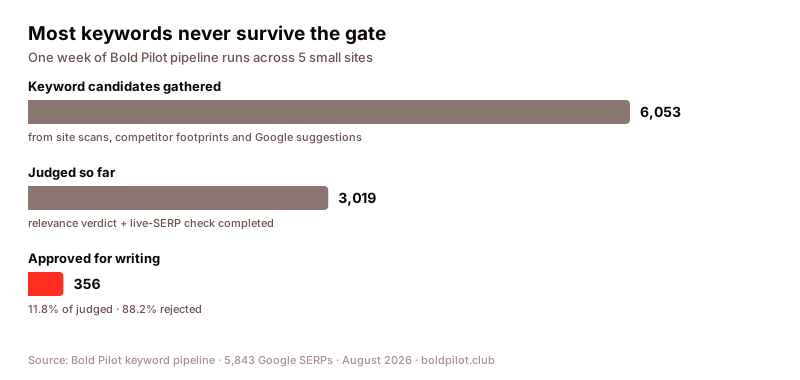
The pipeline starts wide on purpose: site scans, competitor footprints and Google's own suggestion data produced 6,053 candidates for five sites in a single week. Of the 3,019 that have been fully judged so far, 2,663 were rejected and 356 approved.
What kills them is the surprise. We expected competition to be the main executioner. It isn't:
Rejection reason | Keywords | Share of rejections |
|---|---|---|
Irrelevant to the business | 2,203 | 82.7% |
Unwinnable SERP | 456 | 17.1% |
Failed final audit | 4 | 0.2% |
For every keyword rejected because the results page was too strong, nearly five were rejected because the keyword had nothing to do with what the site actually sells. Suggestion data and competitor mining generate volume, but most of that volume is somebody else's topic. If your keyword process has no relevance gate in front of the difficulty check, the difficulty check is mostly scoring keywords you should never have considered.
The median keyword is a 39 out of 100
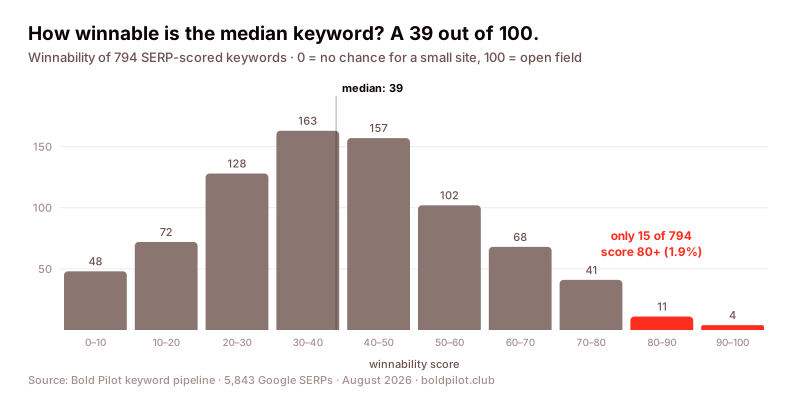
794 keywords went all the way through SERP scoring — a 0–100 winnability estimate built from who actually ranks on page one and how much of that page is reachable for a small site. The distribution is not kind:
Percentile | Winnability score |
|---|---|
25th | 26 |
Median | 39 |
75th | 53 |
90th | 65 |
568 of 794 (71.5%) scored under 50.
124 (15.6%) scored 60 or higher — the band we consider genuinely worth writing for.
15 (1.9%) scored 80 or higher. The "obvious win" is roughly a 1-in-50 event.
The practical reading: a small site that writes ten articles against unfiltered keyword ideas is, on these numbers, spending about seven of them on pages that were structurally unlikely to rank on the day they were planned.
"Low difficulty" does not mean you can win it
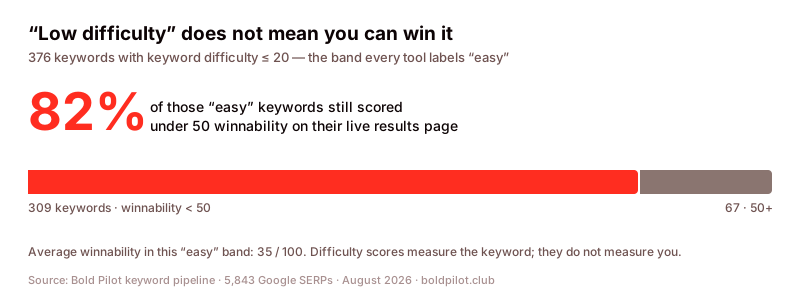
This is the finding we'd want cited most. 376 of our scored keywords carried a keyword difficulty of 20 or lower — the green, "easy" band in every mainstream SEO tool. Checked against their live results pages, those "easy" keywords averaged a winnability of 35, and 309 of them — 82.2% — scored under 50.
The gap has a mechanical explanation. Difficulty scores summarize the link profiles of ranking pages in aggregate; they do not ask who the ranking sites are. A results page can be "low difficulty" on averages while its actual slots are held by Reddit threads, a government page, two DR-80 publishers writing off-topic, and the brand the query names — none of which a new domain displaces regardless of what the aggregate says. The keyword is easy; the page is closed.
If you run a small site, the implication is uncomfortable but useful: a difficulty filter alone is not protecting you. The green keywords in your research tool are mostly still red.
Search volume tells you nothing about your chances
We binned scored keywords by monthly search volume and looked at winnability in each band:
Monthly volume | Keywords | Median winnability |
|---|---|---|
51–250 | 220 | 39 |
251–1,000 | 271 | 39 |
1,000+ | 303 | 39 |
Identical medians, three bands. On this dataset, how many people search for a keyword carries no information about whether a small site can rank for it. The folk rule — "go long-tail, low volume is less competitive" — did not show up in our data at all: the low-volume band was exactly as contested as the high-volume one. Volume decides what a ranking is worth. It says nothing about whether you can have it.
In 1.3% of queries, the brand already owns the top result
A small but instructive slice: for 10 of the 794 scored keywords (1.3%), the #1 result belongs to the brand the query names — searches like a product name plus a question, where the manufacturer's own page holds the top slot. For those queries, position 1 is not difficult; it is definitionally unavailable, and second place is the ceiling. Worth checking before targeting any keyword that contains someone else's brand.
Methodology
All figures come from Bold Pilot's production keyword pipeline, read directly from our database on August 25, 2026.
Sample: 6,053 keyword candidates gathered for 5 small websites (ours among them) between August 12 and 18, 2026. Candidates came from scanning each site's own content, mining competitor footprints, and Google suggestion data.
SERPs: 5,843 live Google results pages fetched (US, English) to score candidates.
Judgment: each candidate passes a relevance verdict (is this the site's topic at all?) and, if relevant, a SERP check. 3,019 candidates had completed judgment at the time of the pull; the rest were still queued.
Winnability is our 0–100 estimate of a small site's realistic chance on a keyword, computed from the live results page: the strength of the domains actually ranking, how many slots are held by sites a new domain cannot displace, and whether the queried brand owns the top result. It is deliberately scored from the SERP itself rather than from keyword-level aggregates — that difference is what the difficulty section above measures. 794 keywords completed this scoring.
Keyword difficulty values are DataForSEO's 0–100 metric, recorded before the SERP check as a pre-filter.
Limitations, honestly: five sites is a small site sample, and all five fit our customer profile — small, young domains — so these numbers describe that situation, not the web at large. The scoring model is our own; a different winnability definition would move the absolute scores, though we'd expect the shape (a low median, a thin right tail, the difficulty gap) to survive. All SERPs are US English. This is one week of data; we plan to republish these figures quarterly as the dataset grows.
Reuse these figures
Every chart and number in this report may be reused, with attribution and a link. Suggested citation: Bold Pilot, "Keyword Winnability Report," August 2026 — based on 5,843 Google results pages. If you need a cut of the data we didn't publish, email ahmet@boldpilot.club and we'll run it.
FAQ
What percentage of keywords can a small website actually rank for?
In our August 2026 dataset of 794 SERP-scored keywords across five small sites, 15.6% scored 60+ for winnability and only 1.9% scored 80+, while 71.5% scored under 50. As a working rule: roughly one keyword idea in six is genuinely worth a small site's writing effort.
Are low-difficulty keywords a safe bet for new websites?
Mostly not. Of 376 keywords rated "easy" (difficulty ≤ 20) by standard metrics, 82% still scored under 50 winnability when checked against their live results page, because difficulty aggregates link metrics without asking who actually holds the ranking slots.
Does targeting low-volume keywords improve a small site's chances?
Not in this dataset. Median winnability was identical — 39 — across the 51–250, 251–1,000 and 1,000+ monthly volume bands. Volume affects what a ranking is worth, not whether you can get it.

📢 Share this article
📚 More articles
LLM optimization tools split into two distinct categories. This guide explains both, compares leading options
An AI content automation bundle can cut publishing time dramatically — here's what each component does, how to stack the tools
AI article generators with images save hours per post — but image quality and SEO vary widely. See what each type does, what to expect, and how to pick one.
Auto publish articles on LinkedIn using RSS, Zapier, the API, or an all-in-one pipeline. Covers tools, limits, and which setup fits your workflow.