AI-Powered Content Creation Platforms: How They Actually Work and What to Expect
AI-powered content creation platforms plan, write, and publish content automatically. Here's how they work, what they cost, and which type fits your situation.
An ai powered content creation platform is a system that pulls keyword research, AI writing, and publishing automation into a single workflow — so instead of stitching together five separate tools, you get a pipeline that takes a topic brief and produces a publishable article, often without a human touching the draft. Worth using? That depends almost entirely on what you're comparing it to. If your current process is a writer, a keyword tool, and a CMS login, the consolidation alone saves real time — and if you're expecting literary prose, you'll be disappointed either way.
These platforms range from simple prompt-to-text generators to fully automated SEO pipelines that select keywords, write to a target length, and push content live on a schedule. The gap between those two things is enormous.
According to getblend.com, more than 75% of marketers now use AI tools to some degree, though only around 19% of businesses have moved to using AI to actually generate content — which tells you most people are still experimenting at the edges rather than running production pipelines. That number is shifting fast, and the platforms driving it are doing much more than autocomplete.
What an AI-powered content creation platform actually does
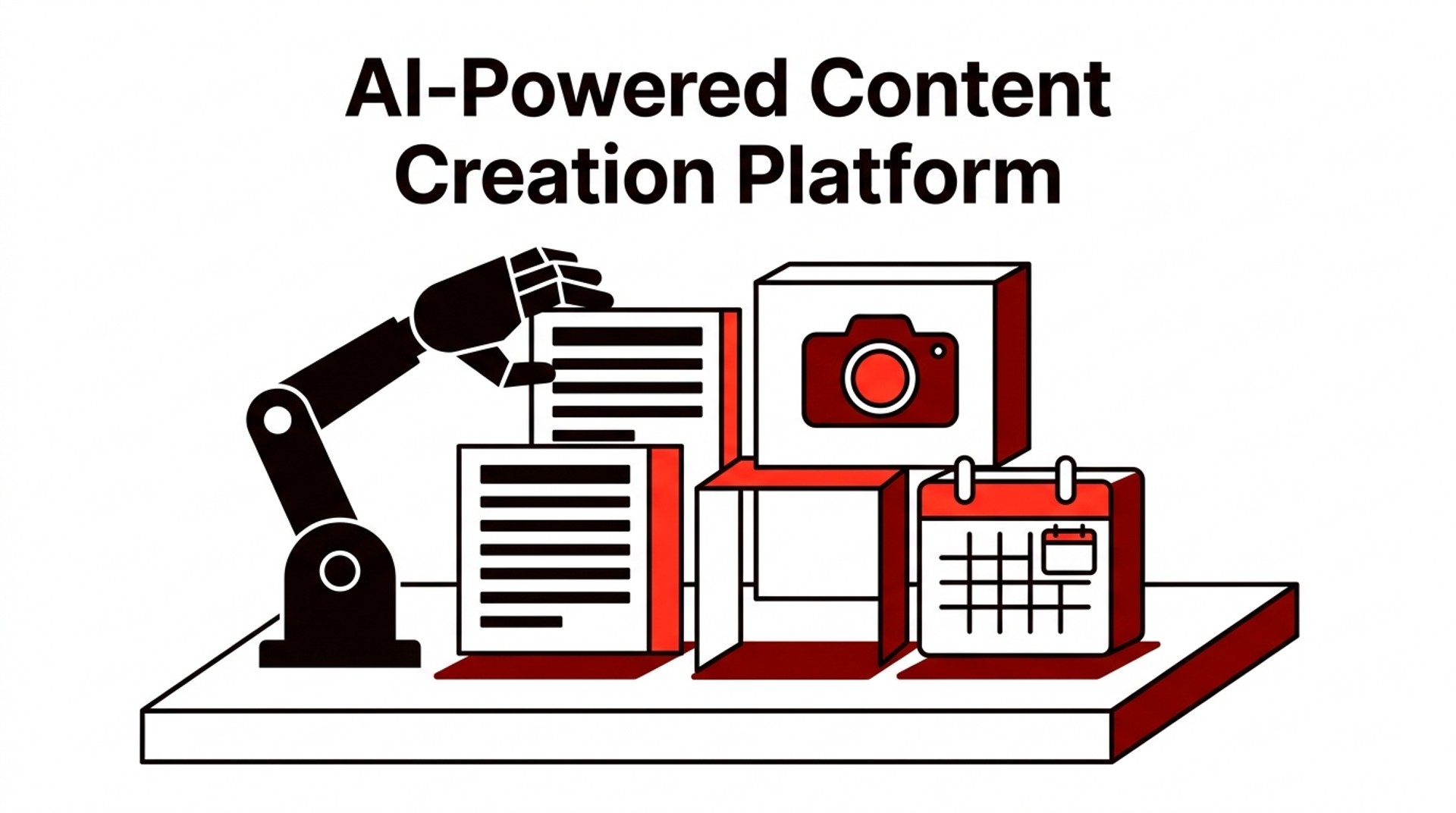
An AI-powered content creation platform manages the entire editorial pipeline — from deciding what to write about, through drafting, all the way to pushing finished content into a CMS — rather than just assisting at one step. That distinction separates these platforms from standalone AI writers like a basic ChatGPT prompt or a single-purpose tool that generates text when you paste in a brief, and it's a distinction that buyers consistently underweight when they're comparing options. Point tools are useful. They just hand the work back.
The pipeline has three stages, and each one feeds the next.
Keyword and topic selection comes first. Rather than simply accepting whatever phrase you type in, the platform pulls search data, evaluates competition, and makes editorial judgments about intent and structural gaps in existing results — decisions that used to require a dedicated SEO strategist. Picking a phrase is the easy part; determining the angle that can actually rank is the real work this stage performs.
AI drafting follows, but it's downstream of research, not the other way around. Before the language model writes a single word, the platform produces a structured brief — heading hierarchy, target length, semantic keywords to cover, questions to answer. Better platforms treat the brief as a hard constraint.
Publishing and scheduling closes the loop. CMS integration means content moves from draft to live without a manual export step, so the cadence runs without someone clicking publish each time. A platform that stops at the draft is a drafting assistant wearing a platform costume.
Why does the research stage matter more than the drafting stage for rankings? Because two articles drafted on identical briefs by the same model will perform very differently if one was built around a high-intent keyword with a clear topical structure and the other wasn't — the language quality is nearly interchangeable at this point, while the strategic layer is not. A closer look at how automated pipelines handle the full production sequence shows where these decisions get made and what happens when the research layer is weak.
⚠️ The common assumption — that writing quality is what separates good platforms from bad ones — misleads buyers. The brief and the keyword logic matter more.
How different platforms handle keyword selection — and why it separates the good from the mediocre
The gap between platforms that drive measurable traffic and ones that produce articles nobody reads almost always traces back to one question: how does the platform decide which keywords are worth writing for in the first place? Broad keyword generators hand you a list of possibilities; smarter systems filter that list against what your site can actually win.
Most platforms default to the easier approach. They take a seed topic, run it through a keyword database, and return hundreds of terms sorted by volume. High volume, broad intent, fierce competition — the kind of list that looks impressive in a spreadsheet and underperforms in search. A personal finance blog with 40 referring domains writing toward "best savings account" is not close to page one; it's in a queue behind institutions that have published on that topic for fifteen years.
Near-ranking keyword logic inverts this. Instead of starting from topic breadth, it starts from your site's existing position data — specifically, the terms where you're already showing up between positions 11 and 30. Google has provisionally indexed the page; it just hasn't decided you're good enough to surface above the fold. A targeted piece or a modest improvement to what's already published often moves a ranking from position 19 to position 7. That's actual traffic, not a theoretical click-through. The targeting strategy is narrower, which is precisely why it converts.
Winnability scoring takes this further by layering intent and competition signals on top of position data. A keyword ranking at position 15 with strong commercial intent and thin competing content scores differently from one sitting inside a cluster of polished comparison pages and authoritative listicles from major publishing brands — even though the raw position number looks identical.
The practical result of rigorous filtering is that most keywords don't clear the bar — and that's a feature, not a failure. Across ten sites, Bold Pilot's keyword winnability analysis found that only 22.4% of 1,488 keywords measured against a live search results page were judged worth writing an article for. Roughly four out of five candidates were discarded before a single word was written. That ratio is the point.
Platforms that skip this filtering stage ship articles that absorb budget and publishing capacity without any realistic path to ranking. The filter is where the editorial judgment lives — even when the writing happens automatically.
Which type of platform fits which situation
The right platform is almost never the most sophisticated one — it's the one that matches how much of the pipeline you want to own. Three broad categories cover most situations: writing-only tools that give you a capable drafting assistant, SEO-plus-writing tools that add research and optimization to the mix, and full-pipeline platforms that handle everything from keyword discovery to publication without you directing each step.
Platform type | Best for | What you still manage | Example tools |
|---|---|---|---|
Writing-only | Solo strategists, low-volume content | Topic selection, SEO research, publishing | ChatGPT, Rytr |
SEO + writing | Content teams with existing workflow | Editorial review, internal linking, publishing | Jasper, Frase, NeuronWriter |
Full-pipeline automation | Founders, agencies, scaling site owners | Approval thresholds, brand voice setup | Bold Pilot, similar |
Writing-only tools make sense when the strategy is already yours and you just need the draft to come faster. According to saascrmreview.com, ChatGPT delivers the most per dollar for a single strategist, and Rytr is the cheapest capable short-form writer at $7.50/month. Speed is the whole value proposition. That's the right call for a freelance consultant who knows exactly which questions their clients are searching for and has no interest in paying for research tooling they'll never open — they need faster fingers on the keyboard, not a more elaborate dashboard.
SEO-plus-writing tools occupy the middle ground. Jasper, Frase, and NeuronWriter all bolt keyword research or on-page scoring onto the drafting layer, which matters enormously for content teams that already have an editor, a publishing workflow, and someone whose job is tracking rankings. saascrmreview.com names Jasper the best overall AI content creation tool for marketing teams, with the Pro plan priced at $59/month billed yearly — a reasonable outlay for a team that publishes consistently and wants optimization guidance folded into the same tool rather than maintained as a separate research stack.
Full-pipeline platforms are a different category of tool solving a different category of problem. An agency running content programs for fourteen B2B clients simultaneously can't afford a human hand on every keyword decision, brief, and publish action. Coordination overhead is the real constraint — not writing speed. And that's precisely where full-pipeline automation earns its cost: the workflow runs across all clients without headcount scaling alongside it.
💡 The mistake most buyers make is reaching for a more powerful tier than their workflow can support. A founder who hasn't nailed their content strategy yet will get worse results from a full-pipeline platform than from ChatGPT, because automation amplifies whatever direction you feed it — and if the direction is wrong, volume makes it worse faster. Start with the simplest tool that removes your current bottleneck. Feature lists are not a strategy.
What AI-generated content actually looks like at scale — length, quality, and what gets published
At volume, AI-generated articles are shorter than most people expect — and that isn't a problem. Bold Pilot's pipeline data, measured across 181 published articles on six sites, shows a median published length of 1,256 words. Well below the 2,000-plus-word targets that SEO lore has pushed for years. The rankings hold up anyway, because length was never the actual mechanism — what changes the outcome is how precisely the article matches the query it's trying to serve.
The mechanism is match quality. When keyword targeting is tight enough that an article addresses a specific query and nothing else, a focused 1,100-word piece will outrank a bloated 2,400-word one that dilutes its own signal across three loosely related subtopics. Shorter AI articles fail when they're vague. They succeed when the structure is clean, the specificity is high, and the internal linking connects the piece to related content the site already has.
That last point — internal linking — is where a lot of AI pipelines fall short at scale. Drafts generated in isolation have no knowledge of the surrounding site. Platforms that pull a live content index before generating will produce links that resolve correctly; the ones that don't will hand you five hundred articles that each read as if the site started the day they were written, often hallucinating anchor text to pages that simply don't exist anywhere on the domain.
Whether human review is necessary depends entirely on the subject matter. Stable topics are manageable. A pipeline producing topical content on something like tax filing deadlines, product care instructions, or ingredient glossaries can run largely unsupervised once the prompts are validated against a sample batch — but anything touching recent events, professional liability, or contested claims needs a human in the loop before publishing, full stop.
What makes AI content sound natural beyond the draft is a less tidy problem than vendors tend to admit. Voice calibration, sentence rhythm, the absence of canned transitional phrases — these require post-generation handling, either through prompt engineering baked into the platform or a light editorial pass, and the difference between handling it well versus skipping it entirely shows up immediately to any careful reader. There's a useful breakdown of what that process involves in this guide on making AI writing sound like a real author, covering the specific elements that need attention after the draft exists.
⚠️ The share of AI-identified keywords that warrant writing about is smaller than the tools imply. Most platforms don't surface the filtering step clearly, so it gets skipped — and query classification, search intent analysis, and competitive difficulty filtering together will cut a raw keyword list by 40–60% before anything publishable should be queued. Platforms that don't build that filtering in will produce volume without direction.
How much AI content creation platforms cost and what you actually get at each tier
Pricing across the market runs from zero to several thousand dollars a month, and the tier you pick determines not just volume but which parts of the workflow you still own manually. The gap between a $9/month writing assistant and a $299/month platform isn't always quality — it's usually how much orchestration the tool handles on your behalf.
Free tools like the base ChatGPT tier handle short-form output, brainstorming, and one-off drafts well enough to be worth using. Where they stop working is anything resembling a repeatable process: no saved brand voice, no keyword integration, no publishing pipeline. You're the workflow. For a solo creator testing whether AI fits their process at all, that's fine. For anyone thinking about consistent output — even two posts a week — the manual overhead accumulates faster than most people expect.
The $7.50–$79/month SaaS range buys a more structured environment. Platforms in this band typically offer templates, some degree of SEO integration, and enough generation volume to produce a dozen or more articles a month, though the draft that comes out usually still needs a human to finish it. Editing time doesn't disappear. It just moves from writing to cleanup — a distinction that matters if the two hours after the draft exists is where your time actually goes. If your bottleneck is the blank page, mid-tier tools solve that problem cleanly.
💸 Full-platform pricing ($79–$299/month) is where automation depth starts to shift meaningfully. Blaze.ai sits at the lower end of that range with a self-serve plan from $79/month, scaling to fully managed services from $999/month — which signals that "platform plus humans" costs roughly an order of magnitude more than software alone, a gap worth holding in mind before assuming the top SaaS tier and a managed service are comparable. At the $299/month level, per saascrmreview.com's breakdown, tools like Oleno target teams whose real problem is briefing and fact-checking rather than raw drafting volume.
Managed content services — agencies or platforms offering human-reviewed, published-ready articles — still routinely charge upwards of $175 per 1,500-word piece, according to getblend.com. That price reflects editorial judgment the software tiers don't include.
The cheapest option is sufficient when output quality has low stakes and volume is low. The moment either of those conditions changes, the downstream rework cost tends to exceed what a higher tier would have run.
Where Bold Pilot fits — and where it doesn't
Bold Pilot occupies a specific lane in the full-pipeline automation category: it finds keywords your site is already close to ranking for, writes SEO-optimized articles around them, and publishes directly to your site without you touching a draft. That three-step loop — discover, write, publish — is the whole product.
The site owners who get the most out of it are running content-light operations that need SEO output at a pace no small team can match manually. Think: one part-time person, eight client sites, a backlog that never shrinks. A SaaS founder who'd rather ship features than brief writers. Or consider the niche site owner who understands that near-ranking keywords represent low-hanging fruit but simply lacks the hours to surface them weekly — let alone research, outline, draft, and schedule articles around them before the window closes. For those profiles, the one-click publishing and the AI-driven keyword recommendation engine aren't conveniences — they're the point.
But the fit breaks down quickly outside that use case. No visual layer exists here at all — Bold Pilot doesn't produce social media content, generate images, or touch video. It also doesn't offer a human editing step, which matters if your brand requires reviewed-and-approved copy before anything goes live: the autonomous publishing model will feel like a liability rather than a feature, and no setting in the product changes that structural reality. Writers who want to remain hands-on with every sentence will find the tool fights their instincts.
A writing-only tool like Jasper makes more sense if you want AI assistance without automation — keyword research and production stay in your hands. A specialist SEO platform like Ahrefs makes more sense if surfacing opportunities is the core need and you already have a production workflow behind it; the two jobs are different enough that conflating them costs time. If you want to dig into how SEO automation platforms differ structurally, this breakdown of how SEO automation software approaches content pipelines covers the distinctions worth knowing before you commit to any one approach.
FAQ
Can an AI content creation platform replace a human content writer entirely?
For most content programs, no. AI platforms handle volume, consistency, and keyword-driven structure well, but they fall short on primary research, genuine expert opinion, and editorial judgment — and that gap is what separates a piece worth sharing from one that merely ranks. The realistic outcome is reduced headcount for routine production work, with human writers redirected toward content that requires real sourcing, subject-matter depth, or brand voice the platform hasn't been trained to replicate.
What is the best free AI-powered content creation platform for beginners?
There isn't a single best option, and the free tiers of most dedicated content platforms are limited enough to make fair comparison difficult. Tools like ChatGPT or Claude give beginners the most flexibility at no cost — you can prompt your way through a draft, iterate, and learn what the output is missing — but they provide no built-in keyword research, publishing workflow, or SEO scaffolding. That means a beginner also needs a separate process for all of those steps. Stitching them together manually is not trivial. If a structured workflow matters from day one, look for platforms offering a genuine free trial rather than a capped free tier, since a trial shows you the full system before any commitment.
How do AI content platforms handle SEO optimization, not just writing?
The gap between platforms is widest here. Entry-level tools generate text and leave SEO to you; mid-tier and specialist platforms pull keyword data from search APIs, analyze the pages currently ranking for a target term, and use that competitive landscape to set targets for word count, heading structure, and semantic coverage before writing begins. Some platforms also handle internal linking, meta descriptions, and schema markup — treating SEO as an input constraint on the draft rather than a checklist applied afterward.
Are AI-generated articles penalized by Google in 2026?
Google's current position is that AI-generated content isn't penalized by default — the standard applied is whether the content is helpful, accurate, and written for people rather than search engines, regardless of how it was produced. Thin AI content that recycles surface-level information without adding anything a reader couldn't get from the top three results does rank poorly, but that's a quality failure, not an AI penalty. The signal Google responds to is depth and relevance. Content produced with proper keyword research, edited for accuracy, and reviewed before publication behaves the same as anything else in search — authorship method simply doesn't appear to be the variable that moves rankings.
How to Decide Which AI Content Platform Category to Investigate First
General-purpose AI writing assistants, SEO-integrated content platforms, and fully automated pipeline tools differ less in the quality of text they produce than in where they hand control back to you. A general-purpose assistant gives you raw drafting speed and almost unlimited flexibility; you supply every strategic decision. An SEO-integrated platform takes over keyword selection and structural optimization but still expects a human to review and publish. A pipeline-automation tool runs from brief to published post with minimal intervention, which is powerful if your content strategy is already locked in and limiting if it isn't.
Text is only half of what most content pipelines need. For the visual side, PhotoGPT generates and edits images and video to go with the articles, which covers the gap most of these writing-focused platforms leave open.
The distinction that matters most in practice is where your current bottleneck actually sits. If you're producing fewer than twenty pieces a month and quality consistency is the problem, a general-purpose tool plus a disciplined editing step probably closes the gap. If keyword research and competitive analysis are consuming most of your team's time, an SEO-integrated platform addresses that directly — the drafting speed becomes a side benefit rather than the point. And if you're running a content operation at scale, where the cost of human review per article has to stay below a certain threshold to keep the program economically viable, pipeline automation is the category worth pricing out first, though you're trading meaningful editorial control for throughput and that exchange doesn't suit every team.
One belief worth examining before you start demoing platforms: many teams assume they need end-to-end automation when what they actually need is to eliminate one specific friction point — usually briefing, or internal review cycles, or publishing coordination — and a lighter tool would handle that without requiring them to rebuild their entire workflow around a new system.
The question that cuts through most platform comparisons is this: do you need the entire content pipeline automated, or just the step where your process is currently slowest — and is that step the drafting itself, the research before it, or the production work that follows?

📢 Share this article
📚 More articles
Generative AI SEO software now splits into three distinct categories. Here's what each one handles, where they overlap
A clear SEO backlinking strategy covering 7 proven link-building methods, when each one works, and how to prioritize them without an agency. Here's how.
Automated ranking content AI handles keyword research, writing, and publishing in one flow. Here's how each stage works, what breaks it
Plugins, standalone tools, or automated pipelines — here's how each AI blog writer for WordPress actually works, what each costs, and which fits your site.