SEO Automation Software: What It Actually Does and How to Pick the Right Stack
SEO automation software handles keyword research, content, and publishing without manual work. See how it works, what to automate first, and how to pick one.
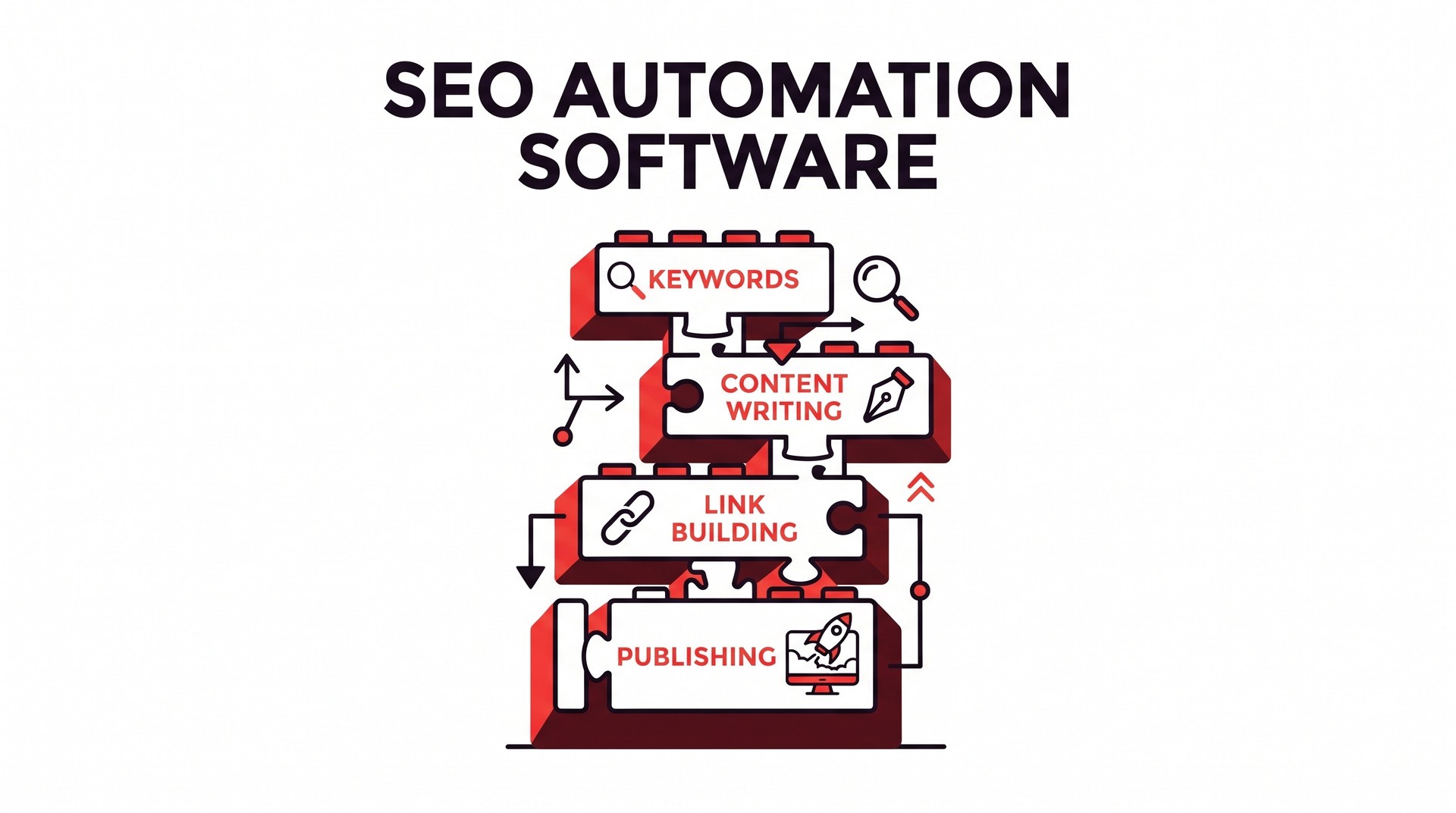
SEO automation software handles the mechanical, repeatable parts of search optimization — crawling and auditing your site, tracking keyword rankings, identifying link opportunities, generating content briefs, and in some cases drafting and publishing articles. The category covers that full sweep. What it cannot replace is the judgment call underneath each of those tasks: deciding which keywords align with your business model, reading a search results page to understand what Google actually wants to rank, or recognizing when a piece of content needs a different argument rather than just more words.
The gap between using these tools and using them well is wider than most buyers expect. According to Siteimprove, 83% of marketers now use AI tools for SEO — but only 4% deploy them strategically, a gap that tracks with what the software itself reveals when you stress-test it. Bold Pilot found that across seven sites using its keyword engine, just 16.6% of 749 evaluated keywords were worth producing an article for. Automation surfaces candidates fast. It does not automatically tell you which ones deserve your budget.
If your problem is throughput — too many repetitive tasks, too little time — this category will help. If the problem is strategy, the tools are only as good as the thinking you bring to them.
What does SEO automation software actually do?
SEO automation software handles the repetitive, data-heavy parts of search optimization — crawling pages for errors, pulling keyword volumes, tracking ranking changes, suggesting internal links — so that human attention can stay on the decisions requiring real judgment. The core value proposition is throughput: tasks that would take an analyst a full day can run overnight without anyone touching a keyboard.
The work breaks down into a few distinct categories. Rank tracking and site auditing are almost entirely hands-off once configured — the software polls search results, flags position drops, and logs crawl errors on a schedule you set. Keyword discovery sits somewhere in the middle: tools like Semrush or Ahrefs surface opportunities automatically, but deciding which of those opportunities maps to a real business goal still requires a person. Content briefs are similar — the software can pull competitor headings, identify semantic gaps, and suggest word counts, but the brief that lands with a writer is shaped by editorial instinct, not a clustering algorithm.
Publishing automation pays off for teams managing high-volume content operations — think programmatic pages for location-based queries or product variants — but only after the template logic has been thought through carefully. Scale the wrong structure and you're just multiplying a mistake faster. That caveat deserves weight before flipping any switch. For a deeper look at how SEO and content strategy interact across a pipeline like this, this breakdown of how content marketing and search optimization connect covers the relationship well.
One thing most people get wrong about this category: no single platform automates the whole SEO pipeline end to end. Every tool — even the most ambitious AI-driven ones — automates a slice, and the slices don't always fit neatly together. One handles technical auditing. Another does rank surveillance; a third generates draft briefs. The ecosystem is modular partly because the underlying problems are technically different and partly because enterprise vendors have no incentive to commoditize adjacent markets.
Some SEO tasks resist automation almost entirely. Brand positioning — how a site is perceived relative to competitors — is strategic and contextual in ways no crawler can model. Editorial judgment about which angle on a topic will build authority is no different. Link outreach is nominally automatable but nearly always performs worse when it is, because the emails read like what they are — and recipients have grown efficient at spotting them. These aren't incidental gaps; they mark where the human work is irreplaceable.
Which SEO tasks are worth automating first?
Start with rank tracking and site audits. They deliver monitoring value immediately, demand almost no configuration, and run on a schedule that surfaces problems before they compound into something harder to fix. A site with 200 pages can accumulate broken internal links, missing meta descriptions, and crawl errors for weeks without anyone noticing — automated audits catch this the moment it appears.
From there, keyword clustering and gap analysis are the next natural move. Hours in a spreadsheet, reduced to minutes. Modern tools collapse the mechanical sorting — which queries belong to the same page, which represent gaps your competitors have already seized — into something that takes a fraction of the time, though a human still needs to sanity-check the output, because software pattern-matching and editorial judgment are not the same thing.
Content brief generation sits a notch above these in complexity. Partially automatable, but the partial is doing real work in that sentence. According to Marketer Milk, one practitioner described the tool helping with roughly 50% of brief creation while still adding their own human insights on top. That split is probably close to right for most teams: structural scaffolding — headings to cover, questions to answer, competitor angles to address — generates quickly. What resists automation is the judgment about what your specific audience needs from a particular piece, and that gap is easier to underestimate than most practitioners expect.
Publishing workflows and internal linking get overlooked more than they should. At small scale, manually adding internal links and pushing content through a CMS feels manageable — but at fifty posts a month it becomes a real bottleneck that erodes quality quietly, because writers start skipping the linking step when it feels like busywork, and those compounding omissions are rarely audited until traffic flatlines. Automating the detection and suggestion of internal links removes that friction without removing editorial control.
⚠️ The mistake worth naming explicitly: automating strategy before you've validated the underlying keyword fit. Volume without validation scales a flawed model — building a content pipeline that generates and publishes at speed, without first confirming that your target queries convert or attract the right audience, is one of the more expensive ways to learn this lesson. This breakdown of a practical SEO strategy workflow lays out the validation steps worth running before any automation touches content production.
The order matters. Monitoring and clustering come first — these give you signal. Briefs and publishing follow once you have that signal to act on. Strategy last, and only once you know what you're optimizing for.
How to tell if a keyword opportunity is actually worth automating content for
A keyword is worth automating content for when you already have some ranking signal for it — a position somewhere between 8 and 30 — and the intent behind it matches what a page on your site can credibly deliver. If neither of those conditions holds, automation just produces content that competes with nothing and ranks for nothing.
The common instinct is to reverse-engineer this: find high-volume keywords, then build content to chase them. That approach feels like scale. In practice it mostly generates pages that sit at position 94 and never move, because the site has no existing authority in that territory and the competition has years of topical depth you can't shortcut around. Volume is almost irrelevant as a first filter. Position and intent match are what determine whether a page can win.
Bold Pilot's keyword engine, measured across seven sites, found that only 16.6% of 749 keywords evaluated against live search results pages were judged worth writing an article for — a figure Bold Pilot published in their research. That's fewer than one in six. The other 83-plus percent were either too competitive, too far from the site's established ranking patterns, or mismatched to what the site could plausibly be about. If your content pipeline is built on the assumption that every keyword your tool surfaces is a candidate, you're automating the wrong inputs.
Three things move a keyword from candidate to viable:
Current ranking position. Somewhere in the second or third page of results is the productive zone — close enough that you have implicit relevance, far enough that there's clear room to rise. Ranking at position 2 already needs optimisation, not a new article. Ranking at 150 probably means the topic doesn't fit your site.
Search intent match. Informational queries pointing at a site that only has product pages, or transactional queries aimed at a blog without conversion infrastructure — both are dead ends regardless of difficulty score.
Real competition, not just keyword difficulty. Difficulty scores average across many pages; what matters is whether the specific results on page one include sites you can outpace in the next three months. If every result is a major publisher or a government domain, difficulty scores are lying to you in a flattering direction.
For teams building out an automated content process, the filtering stage is where the outcome is decided — not in the generation step. Getting 83% of your candidates wrong before you write a word wastes crawl budget, dilutes topical authority, and trains your audience to associate your site with thin content. The methodology behind how these thresholds are set, including how position windows and intent categories were defined, is covered in detail in Bold Pilot's keyword winnability methodology and findings.
The question worth asking before any automation run isn't "what can I generate?" — it's "what do I already almost rank for?"
What types of SEO automation software exist and how they differ
SEO automation software falls into four practical categories: monitoring and audit tools, content generation tools, end-to-end pipeline platforms, and workflow builders. Each solves a different part of the problem, and conflating them leads to buying tools that duplicate each other or that don't cover the gap you actually have.
Category | What it automates | Best for | Example tools |
|---|---|---|---|
Monitoring & audit | Rank tracking, crawl errors, backlink alerts | Teams with existing content workflows | Ahrefs, Screaming Frog, SE Ranking |
Content generation | Briefs, drafts, internal links | Teams bottlenecked on content volume | Surfer SEO, Frase, Jasper |
End-to-end platforms | Keyword research through published article | Teams wanting the full pipeline handled | Gumloop, MarketMuse, Clearscope + integrations |
Workflow builders | Custom multi-step automations | Technical teams who want bespoke pipelines | Make, Zapier, Gumloop |
Monitoring and audit tools are the oldest category and the most mature. Rank trackers watch your positions daily without anyone logging in to check; crawlers surface broken links, thin pages, and indexing problems before Google notices them first. The limitation is that they observe and flag — they don't act. A team that already produces content at a reasonable pace and just needs visibility will find these tools sufficient on their own.
Content-focused tools solve a different constraint entirely. The bottleneck here is volume. Tools like Surfer or Frase accelerate brief creation, drafting, and copy optimization without demanding any technical setup from the people using them. A 12-person content agency handling 40 articles a month will likely find this category more valuable than a sophisticated crawler that flags problems no one has capacity to fix — particularly when the alternative is expanding headcount.
End-to-end platforms make the most ambitious promise in this space: keyword in, published article out, with ranking data cycling back into future decisions. That promise holds for predictable content types — programmatic location pages, product descriptions, FAQ content. Seams appear fast, though, on anything requiring editorial judgment, genuine brand voice, or subject-matter depth that can't be templated away.
⚠️ Workflow builders like Make or Gumloop deserve separate mention because they don't fit cleanly into "SEO tool." They're automation infrastructure that you assemble yourself — connecting an Ahrefs export to an AI writer to a CMS publish action, for instance. The ceiling is high, but so is the setup cost, and those two facts are inseparable. A solo founder or small team without a technical operator will spend more time maintaining the workflow than the workflow saves.
The honest framing: these categories aren't mutually exclusive, and most mature SEO operations run at least two of them.
Can ChatGPT or free tools handle SEO automation?
For light-touch tasks like drafting meta descriptions, brainstorming title variations, or fleshing out a content brief, ChatGPT is capable — but capable isn't the same as automated. It has no access to live keyword data, no rank tracking, and no way to push content into your CMS without you doing the pasting, which means the moment you close the chat window, nothing continues running.
That distinction — between AI assistance and actual automation — is the one most solo site owners underestimate. Automation runs on a schedule without ongoing prompting. It pulls data, flags anomalies, publishes drafts, or updates internal links while you're doing something else entirely, operating independently of whether you remembered to open a browser tab. ChatGPT waits for instructions. Useful, but a different category of tool entirely, and conflating them leads to a false sense of coverage. If you want a clearer picture of what a purpose-built AI writing workflow actually looks like in practice, that breakdown is worth reading before you commit to any stack.
Free tiers of dedicated SEO tools are more useful than most people give them credit for, with one significant caveat: they monitor, they don't act. Google Search Console surfaces crawl errors, impressions, and CTR data that you'd otherwise be flying blind without. Ahrefs Webmaster Tools gives you a solid backlink profile and on-page issue reports for a single verified site, for nothing. Screaming Frog's free tier crawls up to 500 URLs — not a toy. Put these three together and a solo blogger running a niche site can diagnose most technical problems without spending a dollar on tooling.
The ceiling appears when you try to connect them. Search Console doesn't talk to Screaming Frog. Ahrefs won't trigger a content update. ChatGPT can't read your GSC data and act on it. The integration layer is where paid platforms earn their cost, not through any single feature that free tools lack, but because they wire the workflow together.
A realistic free starting stack for a small site: Search Console for performance monitoring, Ahrefs Webmaster Tools for link and audit data, Screaming Frog (free tier) for crawls, and ChatGPT for drafting. That covers observation and assisted creation. It covers almost nothing in the way of automation proper.
Which SEO automation software fits which team size and use case
The right tool is almost never the most powerful one — it's the one that matches how much SEO infrastructure you actually have. A solo blogger and a digital agency share almost no requirements, and buying toward the agency end when you're running a single niche site just means paying for dashboards you'll never open.
Solo blogger or niche site owner: Start with rank tracking (Mangools or SerpWatcher will do) and one AI content tool. Low overhead, not a sophisticated stack. You don't need automated internal linking or crawl alerts when you're publishing twice a month — those tools will sit idle and drain budget while delivering nothing you couldn't have spotted yourself.
SaaS founder with no dedicated SEO team: This is where the mismatch hurts most. Something needs to run without you micromanaging it — ideally a pipeline that identifies near-ranking keyword opportunities and turns them into published content without requiring an editor or SEO analyst in the loop. Bold Pilot is built for exactly this profile. It handles keyword selection biased toward pages already close to ranking, generates long-form drafts (the median article published through Bold Pilot runs 3,672 words, measured across 83 published articles on five sites, per Bold Pilot's own published data), and publishes autonomously. Not a rank tracker. It won't run a technical audit or flag crawl errors — if your site has structural issues, a separate tool like Screaming Frog or Ahrefs is still necessary to surface them. Bold Pilot fills the content production and publishing gap, not the diagnostics gap.
Content marketing team: A team with dedicated writers and an SEO lead usually gets more from specialized tools than from any all-in-one, though that's only true once the handoff process is actually designed. Clearscope or Surfer for optimization, a brief tool like Frase, and Ahrefs or Semrush for tracking — these integrate into editorial workflows in ways that consolidated platforms rarely match. The coordination cost is real, but the output quality justifies it when you have people managing the transitions between stages.
Digital agency managing multiple clients: Multi-site reporting and white-label output matter here more than content generation speed — that priority shift changes everything about which tools make sense. Platforms with API access or client-facing dashboards — AgencyAnalytics, DashThis, or end-to-end tools with white-label options — fit better than tools optimized for a single site's editorial pipeline. For agencies specifically considering autonomous publishing at scale, this breakdown of agency-focused SEO software options covers where end-to-end platforms fit relative to point solutions.
The simplest heuristic: if you have SEO staff, buy specialized tools and let them compose a stack. If you don't, an autonomous pipeline beats a suite you won't configure correctly.
Is SEO dead now that AI answers questions directly?
No — but the version of SEO that relied on stuffing ten blue links onto a results page and waiting for clicks is shrinking fast. AI Overviews and answer engines absorb a real share of informational queries, and that shift is structural, not a blip worth explaining away with the usual "SEO has always evolved" reassurance that fills most agency blog posts on this topic.
The honest picture is more granular. Queries where someone wants a quick fact — a conversion formula, a medication dosage, a definition — are being answered before the user scrolls to organic results. That traffic is eroding, and no amount of technical SEO recovers it. Transactional intent is a different story. Someone comparing vendors, pricing a project, or vetting a software tool before a purchase decision still clicks through. The intent requires more than a paragraph of synthesised text, and search engines know it.
What's shifting underneath all this is where the game is actually played. SEO automation software is increasingly built to influence AI recommendation engines — the citations inside Perplexity answers, the sources surfaced in ChatGPT's web browsing, the brand mentions that feed into Google's AI Overviews — not just to rank fifth on page one. That reorientation isn't subtle once you see it: the whole optimisation target has moved. If this framing is new to you, the tools and strategies for improving AI search visibility are worth understanding before you set your next quarter's priorities.
The opportunity gap here is significant. According to Siteimprove, 83% of marketers use AI tools but only 4% use them strategically. That gap isn't a flattering statistic about the 4% — it's a description of how disorganised the field is, which means early coordination still produces outsized returns.
The argument for investing in SEO automation software right now isn't that SEO is thriving unchanged. It's that automation raises the execution floor industry-wide. Teams that don't adopt it fall further behind faster, not because the technology is magic, but because competitors using it are simply producing more, testing more, and iterating faster. Doing nothing has become the expensive option.
FAQ
What is the best automated SEO software?
There is no single best option. The right tool depends on what's slowing you down, and the answer shifts considerably depending on whether you're a solo operator or part of a larger team — Semrush and Ahrefs are strong all-around platforms for keyword research, rank tracking, and technical audits; Screaming Frog handles deep technical crawls better than most; and tools like Surfer or Clearscope specialize in content optimization. A solo operator and a 20-person content team will need entirely different stacks, so the more useful question is which specific bottleneck costs you the most time each week.
Can I do SEO on my own without hiring an agency?
Yes, especially if your site is early-stage or operates in a mid-competition niche. Modern SEO automation software has made the mechanical parts of the job — crawl auditing, rank tracking, keyword clustering — accessible without specialist expertise, which removes the most common justification for bringing in outside help. Agencies earn their fee in three situations: link acquisition, technical migrations on large sites, and content volumes that simply exceed what a small team can manage. Many founders and in-house marketers handle SEO entirely on their own using a combination of a mid-tier platform like Semrush and a writing-assist tool, delegating to agencies only when scope justifiably expands. When scope does expand that far, the choice is a full-service provider rather than another tool: Tấn Phát Digital's SEO service is one example at that end of the market.
What is SEO automation and how does it work?
SEO automation software replaces repetitive, rules-based tasks — rank tracking, site crawling, internal link suggestions, content brief generation — with processes that run on a schedule or trigger on a signal. No manual initiation required. Most tools connect to search APIs, crawl your site or competitors', and surface prioritized recommendations inside a dashboard or push them to a workflow tool like Slack or Notion, which means the data arrives whether or not anyone remembered to go looking for it — a structural advantage that compounds quietly over months. The underlying logic is still set by a strategist; what automation handles is the data collection, monitoring, and first-pass analysis that would otherwise consume hours of routine work each week, leaving little time for the decisions only a human can make.
How to decide which SEO automation layer to add first
The most common mistake teams make is buying a platform before diagnosing which layer is broken. Spending $400 a month on an enterprise rank-tracking suite when the real problem is that nobody is producing enough content — or vice versa, hiring writers before anyone knows which keywords are worth targeting — wastes budget in the most avoidable way.
A cleaner starting point: audit where hours are disappearing right now, not where you think the SEO gap is.
If you're a solo operator or a founder doing SEO alongside other work, the single most impactful first layer is keyword research and content brief automation. Tools like Semrush's Keyword Magic Tool or Ahrefs' Content Gap report, used on a weekly cadence, surface what's worth writing before you spend time producing anything. The output doesn't have to be a fully automated brief — even a structured template populated with search volume, difficulty, and SERP intent cuts briefing time by more than half. Start there, build a backlog of validated topics, then layer in rank tracking once you have enough published content to monitor.
For a small in-house team of two to five people, the first bottleneck is usually technical SEO hygiene that nobody has time to revisit consistently. A scheduled crawl via Screaming Frog or Sitebulb, piped into a shared Slack channel, removes the "we'll fix it later" drift that accumulates on growing sites. That layer costs relatively little and runs without anyone touching it — freeing the team's attention for content and link work, which don't automate as cleanly.
For content-heavy operations producing 20 or more pieces a month, the constraint is almost always content optimization and internal linking. At that volume, manually checking every article against top-ranking competitors isn't realistic. A tool like Surfer or Link Whisper doesn't remove editorial judgment, but it compresses the mechanical pass from 45 minutes per article to under ten.
The sequencing matters more than the tools themselves. Automating distribution before fixing crawlability, or scaling content before establishing keyword strategy, produces more of the wrong work faster — it doesn't compound. Pick the layer that maps to your current constraint, run it for 60 to 90 days, and then measure whether the bottleneck actually moved before introducing the next layer, because adding tools on top of an unresolved constraint rarely surfaces the underlying problem.
One last thing worth sitting with: SEO results on new content typically take three to six months to appear in rankings, which means the teams that delay building even a minimal automation stack are losing more than setup time. They lose the compounding window itself — a site that starts tracking and optimizing in month one will have six months of ranking data by month seven, while a site that waits until month four to configure anything is still flying partly blind at month ten. Spending more later doesn't close that gap. The advantage accumulates from the moment you start, not from the moment the budget feels comfortable.

📢 Share this article
📚 More articles
A clear SEO backlinking strategy covering 7 proven link-building methods, when each one works, and how to prioritize them without an agency. Here's how.
Automated ranking content AI handles keyword research, writing, and publishing in one flow. Here's how each stage works, what breaks it
Plugins, standalone tools, or automated pipelines — here's how each AI blog writer for WordPress actually works, what each costs, and which fits your site.
Automatic article publishing software handles keyword research, writing, and CMS delivery in one flow. See how the pipeline works and what each stage costs.