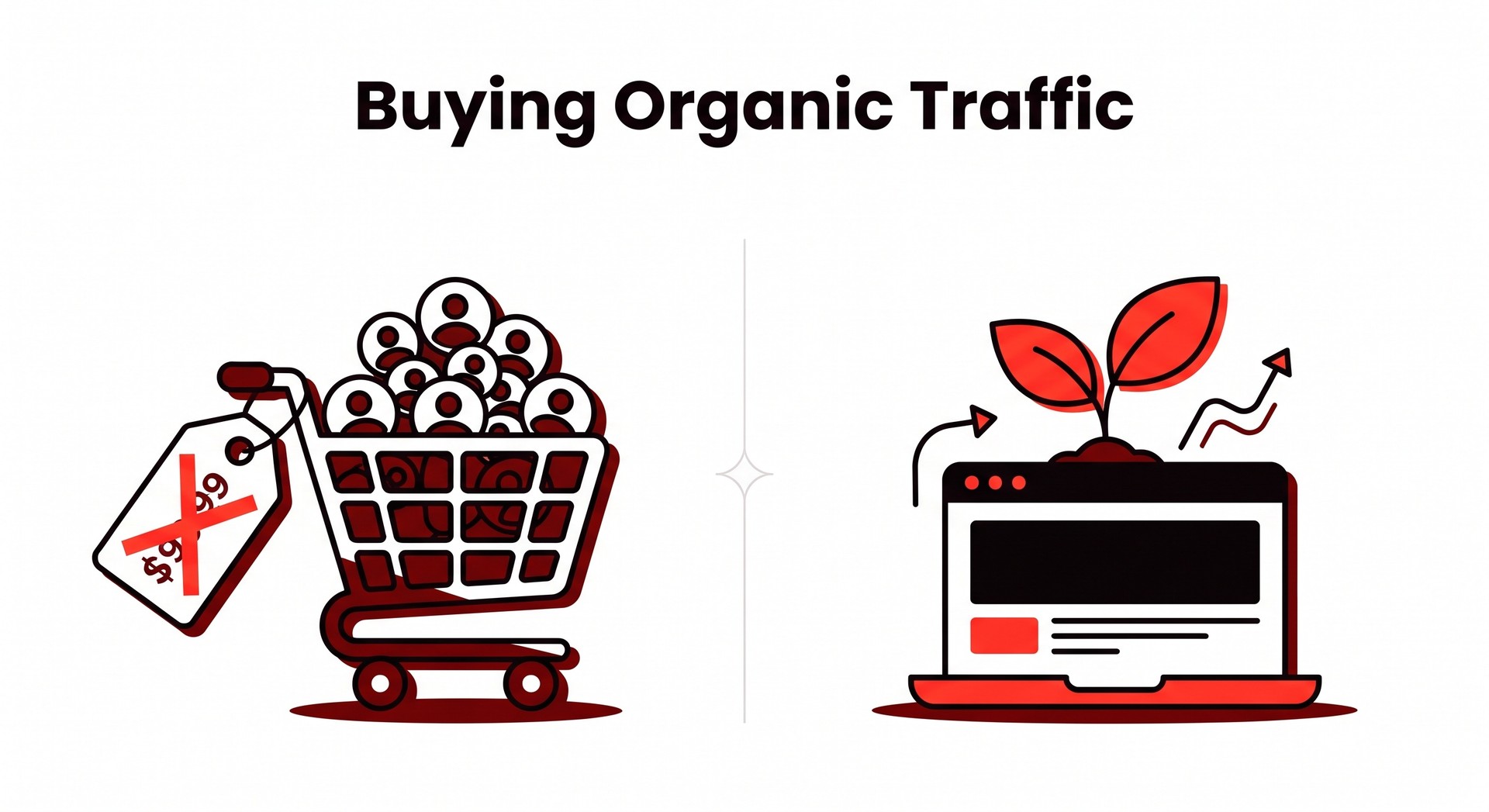
Buying Organic Traffic: What It Actually Does to Your Rankings (and What to Do Instead)
Buying organic traffic can lift CTR signals but rarely builds lasting rankings. See what the data shows, the risks to expect, and what to do instead.
Buying organic traffic from a third-party service does not improve your search rankings in any lasting way. What these services actually sell is simulated engagement — bots or low-paid workers performing scripted searches, clicking your URL, and bouncing after a few seconds. Detect this pattern is exactly what Google's systems are built to do. The core risk: if the manipulation is flagged, you're looking at a manual penalty or algorithmic demotion that can take months to recover from, assuming recovery is possible at all.
The one narrow scenario where purchased click signals might nudge a metric is in very low-competition niches where Google hasn't yet built a reliable behavioral baseline for a query. Fragile and temporary. Even there, the moment Google recalibrates, the bump disappears — and the recalibration tends to come faster than most buyers expect. According to SerpClix, fewer than 1% of users ever click past page one, which explains why ranking at the top carries such outsized value and why the temptation to shortcut it is understandable. But the services selling that shortcut are selling the appearance of a signal, not the signal itself.
What 'organic traffic' services are actually selling
Most services selling "organic traffic" are not selling organic traffic. They are selling simulated search behavior — sessions manufactured to look like a real person found your site through Google, spent time on it, and left on their own terms. Mechanism varies. And that variation matters more than the sales page will ever tell you.
Three distinct product categories get bundled under the same label:
Bot traffic — automated scripts that hit URLs directly, generating pageviews with no real browser rendering and no human involvement.
Residential proxy sessions — requests routed through real consumer IP addresses, making them harder to filter but still automated at the behavioral layer.
Clicker networks — panels of actual humans paid to search a target keyword, find a listing, and click through. SerpClix operates on this model, recruiting real users to perform scripted search actions.
The pitch for the latter two usually includes "dwell time controls" and "GA4-visible sessions." Dwell time controls mean the session stays on-page for a configured number of seconds before exiting; GA4-visible means the session fires the tracking script and appears in your analytics dashboard. Neither proves anything about search engine response. Google's ranking systems do not read your GA4 data.
Pricing across these services typically runs from roughly $10 for a small traffic package to a few hundred dollars monthly for volume tiers — cheap enough that the purchase feels low-risk, which is part of the design.
Does buying traffic actually improve search rankings?
Occasionally, in narrow conditions, yes — but the evidence is far shakier than most vendors let on, and the effect rarely holds.
SerpClix documents a case where a client's listing moved from an average position of 4.7 to 1.7 in roughly seven days through purchased click traffic. That's a striking number. What it does not establish is causation — no controls, no comparison site, no isolation of the CTR variable from anything else happening to that domain during that week. It also says nothing about whether the gain held at 30 days, 90 days, or after a core update. A single vendor case study is not a reproducible experiment.
The underlying mechanism being targeted — click-through rate as a ranking signal — is real. Gaming it at volume, though, produces patterns that are detectable at scale. Google has acknowledged that user behavior data informs its systems, and sessions with suspiciously uniform dwell times, traffic arriving from the same proxy pools, or bounce behavior that doesn't match organic intent all leave fingerprints that its spam infrastructure is increasingly well-equipped to catch. Google's guidelines on artificial engagement signals have been explicit for years.
The skepticism you'll find across Reddit and Quora threads on this topic is well-founded. Most people asking "does buying organic traffic work?" have already seen a vendor pitch and sensed something was off — that instinct holds up, because the fragility of the effect is precisely what vendors bury in their case studies.
What are the real risks of buying organic traffic?
The clearest risk is a manual action from Google — not a vague algorithmic nudge, but a documented penalty that can delist individual pages or an entire site. Delisting hurts. Google's spam policies explicitly target artificial engagement signals, and a human reviewer who spots purchased traffic patterns has the authority to remove pages that were otherwise building genuine authority through months of real editorial work. That authority doesn't come back automatically when the penalty is lifted.
Below the nuclear option, the damage is quieter but still real. Bots don't read. Services that route traffic through low-quality proxy networks inflate raw session counts without generating the behavior those sessions are supposed to signal — actual reading, scrolling, clicking through to a second page, the kind of engagement pattern that tells a search engine the content served a genuine need. The result is a worse bounce rate and shorter average dwell time. You've paid to make your engagement metrics look worse.
⚠️ Vendors often point to repeat-purchase rates as evidence the tactic delivers lasting value. An 86% repeat rate tells you buyers kept buying — not that the purchased traffic compounded into anything durable. It reflects habit, or sunk-cost inertia, not proof of a working strategy. Repeat purchases are a loyalty signal about the vendor relationship, full stop — they say nothing about whether the traffic moved a ranking, held a position, or produced a conversion that wouldn't have happened anyway.
The asymmetry here is uncomfortable: the cost of a manual penalty on a page that has spent six months building real links is permanent in a way that a refunded invoice is not.
When does paid traffic make sense — and when does it not?
Paid traffic earns its place in two narrow situations: running transparent ad campaigns through Google Ads or Bing that send real searchers to your page, and stress-testing a landing page's conversion rate before committing to an SEO build-out. Neither of those involves manufactured organic signals, and neither pretends to move rankings.
Scenario | Legitimate? | Ranking benefit | When it makes sense |
|---|---|---|---|
Google Ads / Bing paid search | ✅ Yes | None — and that's fine | Driving real buyers while organic builds |
Buying targeted traffic to test CRO | ✅ Yes, with caveats | None | Pre-SEO validation of a new page |
"Organic-style" click services | ❌ No | None reliably; policy risk | Never |
The CRO testing case is where things get messier. A SaaS founder once ran $200 through a traffic service and pulled in around 800 sessions — a 94% bounce rate followed. His instinct was that the service had failed him. It had, but the failure was diagnostic, not directional: the bounce data was genuine enough to expose that his product page was doing the actual damage, and that's actually a useful output from a deeply flawed instrument. Real user testing or a small Google Ads campaign would have produced the same signal without the policy exposure.
For anyone weighing how paid and organic strategies interact across the full funnel, the dividing line is transparency. Ads you declare, pay for openly, and account for rigorously are a legitimate tool — the kind that compound data rather than risk it. Services selling rank manipulation dressed up as organic behaviour are a different category entirely, and competitive commercial terms are where they fail hardest and cost most.
What builds organic traffic that compounds over time
The most reliable path to compounding organic traffic is narrow and unglamorous: find keywords your site is already close to ranking for, write the best available answer to each one, and repeat consistently. Pages sitting at positions 11–20 are far more movable than blank-slate terms, and a single well-executed piece pushing a near-ranking keyword from position 14 to position 6 can double its traffic overnight — because that's where the click-through curve gets steep enough that one position swap changes everything about the numbers you're looking at.
Selectivity matters more than volume. Most keywords aren't worth pursuing — too competitive, too vague, or too thin in intent to convert to anything useful. Choose fewer, better targets. That discipline compounds faster than publishing at scale without it.
This is the logic that Bold Pilot automates: it surfaces near-ranking opportunities from your Search Console data and handles the production pipeline from brief to published post. One limitation worth naming up front: it's built for teams running at content scale, so if you're publishing once a month, the onboarding overhead outweighs the benefit. Replicating it manually means sorting Search Console's Performance report by position, filtering for queries landing between 11 and 20, and working down the list in order of estimated traffic gap — slower, but the same underlying logic applies.
On content depth: across 124 articles published through the platform on five sites, Bold Pilot's benchmark data shows a median article length of 3,674 words — a concrete signal of what's actually clearing the bar in competitive search results. That's not a target to hit mechanically, but it suggests that thin content rarely compounds.
How long does real organic traffic take to show up?
For most new content on an established domain, expect indexing within days but meaningful ranking movement over 4–12 weeks — and that's only for low-competition keywords. The timeline stretches considerably from there, and paid-traffic vendors exploit exactly this gap.
The stage that catches people off guard most is the brand-new domain. No shortcut bypasses what's coming. Regardless of content quality, a new site typically needs 6–12 months before any keyword earns real traction, because Google's trust signals — backlink profile, engagement history, crawl frequency — accumulate through ordinary use and cannot be rushed by any method that currently exists without introducing new risks. This is precisely when the temptation to buy "organic-looking" sessions peaks, and also when it carries the most risk: a penalty on a site that hasn't yet established authority is extraordinarily hard to recover from.
The more tractable opportunity sits in positions 11–20. Rankings respond faster here. A page already scraping the second page of results can move into the top ten within 2–6 weeks if the right optimizations land — which is why understanding keyword winnability before you publish matters more than most guides admit, and why that judgment call shapes the entire content calendar rather than just a single post. That assessment framework, explained in this breakdown of how to evaluate keyword difficulty in 2026, changes how you prioritize entirely.
None of this compresses to 24–48 hours. Paid traffic services can deliver sessions inside that window. The mechanism breaks there, though. What those services cannot deliver is the ranking signal those sessions are supposed to represent — because Google's systems don't respond to sudden traffic volume the way vendors imply, and no amount of injected clicks substitutes for the behavioral patterns that accumulate from an audience that found you through search in the first place.
FAQ
What is the difference between organic traffic and paid traffic?
Organic traffic comes from unpaid search results — a user types a query, Google surfaces your page based on relevance and authority, and the visit costs nothing per click. Paid traffic covers any session you purchase directly, whether through Google Ads, a traffic reseller, or a bot network. Budget stops; visits stop. The distinction matters because organic traffic, once earned, compounds across months and years: each month it exists, it keeps working without further spend, while paid traffic leaves no residual effect on your rankings or audience once billing stops.
How do I get organic traffic to my website for free?
The most reliable path is publishing content that matches what your target audience is already searching for, then building enough credibility — through backlinks and topical depth — that search engines treat your site as an authoritative source. Practically, that means identifying specific queries your site could realistically rank for, writing pieces that answer them better than the current top results, and earning links from relevant sites in your space. Each piece that ranks keeps delivering visits. No further spend required.
Will buying web traffic get my site penalized by Google?
It depends on what you buy. Genuine paid advertising through Google Ads operates within Google's rules and carries no penalty risk — you're paying for ads, not for manipulated organic signals. Purchasing bot traffic or fake clicks from a third-party reseller, on the other hand, violates Google's spam policies and can result in a manual action or algorithmic demotion, particularly if the service also builds manipulative links or artificially inflates engagement metrics that Google uses to assess page quality.
What is organic traffic and why does it matter for SEO?
Organic traffic is any visit that arrives through an unpaid search result — no ad spend, just a search engine judging your page relevant to the query. It matters for SEO because it functions as both a signal and a reward: ranking well drives organic visits, and genuine user engagement from those visits (time on page, low bounce rates, return visits) can reinforce your position over time. For most websites, organic search is also the highest-intent traffic source, because the visitor arrived while actively looking for what you offer.
Should you buy organic traffic, or invest in building it?
If the goal is rankings that hold up past the next billing cycle, buying traffic from a third-party service is not a shortcut — it is a detour. The sessions arrive, the dashboard looks better for a week or two, and then either Google notices the anomalous pattern or the subscription lapses and the numbers fall back to where they started. Either outcome leaves the site in roughly the same position as before, minus the money spent.
The argument for real SEO is not that it is easy or fast. It isn't. A new site targeting moderately competitive keywords should expect six to twelve months before rankings stabilize enough to drive meaningful volume, and even well-established sites can wait three to four months after publishing before a piece climbs into a position worth caring about. That timeline frustrates founders and marketing teams under pressure to show growth quarter over quarter, and the frustration is understandable.
But the compounding effect is real in a way that purchased sessions simply are not. A page that earns a position 4 ranking in month eight keeps earning visits in month twenty, month thirty, without additional spend. Each new piece of content that ranks adds to a base that already exists rather than replacing it. The site's authority, accumulated through earned links and topical depth, makes subsequent content easier to rank — none of that accrues to a site that spent the same period buying bot traffic, which has sessions in a spreadsheet and nothing structural to show for them.
The practical decision today is narrower than it might seem. Open Google Search Console and filter your pages by position 11–20. Those pages have already been evaluated by Google as relevant to real queries. They're ranking — just not on the first page. A targeted effort on them produces faster, more measurable results than starting from scratch, because the foundational relevance signal is already in place. Improving content depth and picking up a handful of relevant links can move a result from page two to page one within weeks.
By contrast, a brand-new piece of content targeting the same query would need to build that signal from zero — a meaningful difference in time and effort. That is the specific first step worth taking this week: pull the list from Search Console, pick the two or three pages sitting closest to page one, and treat them as the first project rather than publishing something new.

📢 Share this article
📚 More articles
Automated ranking content editors score and optimize your articles for SEO—but the gap between editing and publishing matters.
Automated ranking content SEO combines keyword selection, AI writing, and publishing in one pipeline.
Generative AI SEO software now splits into three distinct categories. Here's what each one handles, where they overlap
A clear SEO backlinking strategy covering 7 proven link-building methods, when each one works, and how to prioritize them without an agency. Here's how.